How to Become a Temenos T24 Developer in 2026: Complete Beginner's Roadmap

Introduction
Banking technology is very different from building a typical web or mobile application.
When a customer checks their account balance, transfers money, opens an account, makes a payment, or applies for a loan, multiple systems may work together behind the scenes. At the center of many banking environments is a core banking platform that manages critical financial processes.
One of the best-known platforms in this space is Temenos T24, now known as Temenos Transact.
If you're a software developer, tester, business analyst, or IT professional considering a move into banking technology, becoming a T24 developer can be an interesting career path. But learning T24 isn't simply about learning another software product.
You need to understand banking + core banking + T24/Temenos Transact + APIs + databases + integration + testing + enterprise architecture.
This guide explains how to approach that journey in 2026, what skills to learn, what practical projects to work on, and how to become ready for real-world T24 development work.
New to the platform? Start with our beginner guide: What Is Temenos T24? A Beginner's Guide to Core Banking.
What Is Temenos T24?
Temenos T24 is the widely recognized historical name for Temenos' core banking platform. The product is now known as Temenos Transact, although T24 remains a common term in the banking technology industry.
Temenos describes its current banking technology as API-first, cloud-native and cloud-agnostic, with core banking capabilities covering areas such as retail, corporate, treasury, wealth and payments.
A core banking system is responsible for important banking operations such as:
- Customer management
- Accounts
- Deposits
- Loans
- Payments
- Transactions
- Product management
- Interest and charges
- Financial records
A simplified architecture looks like this:
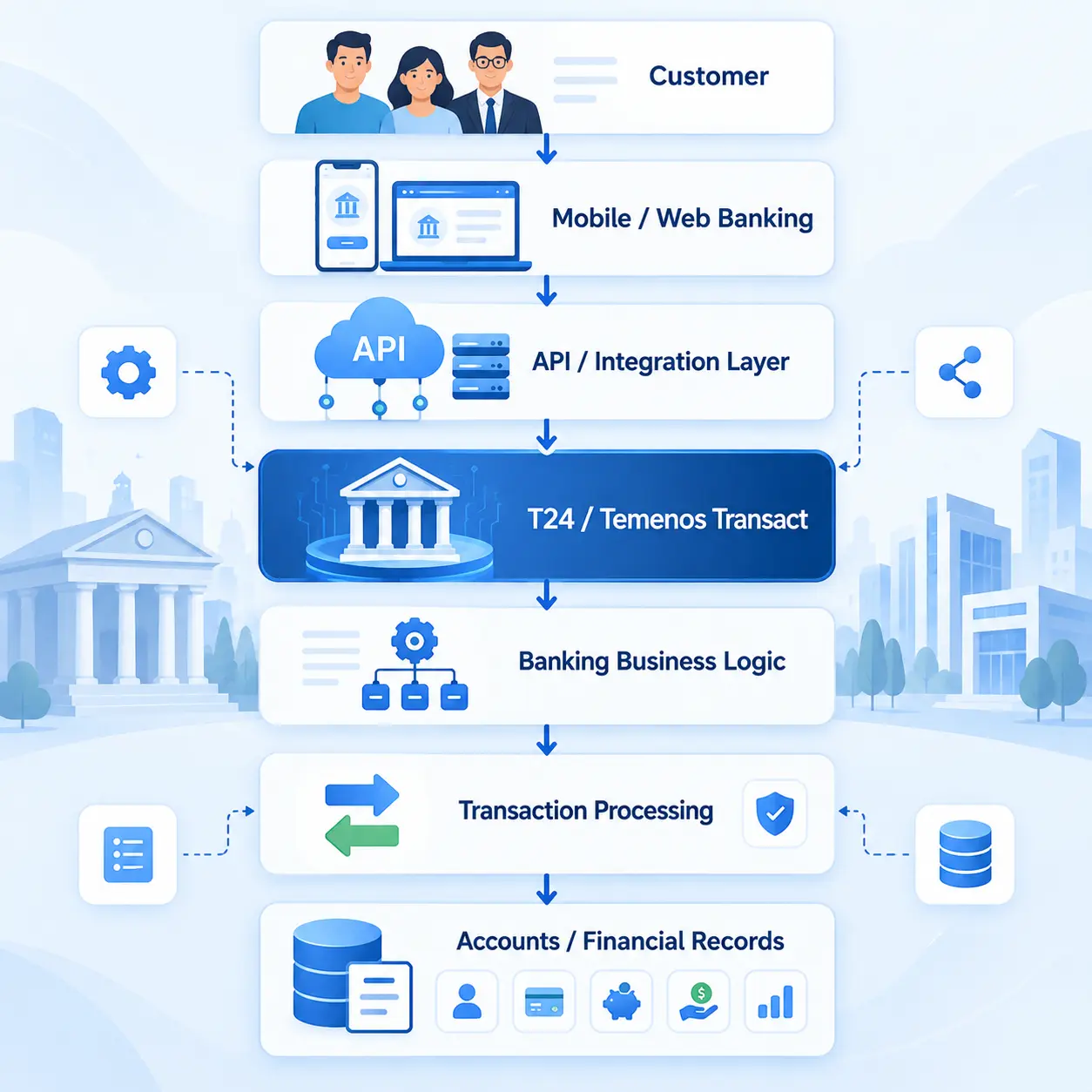
This is why a T24 developer needs to understand much more than programming syntax.
Is T24 Still Relevant in 2026?
Yes, but there is an important distinction to understand.
T24 is the name many professionals still use, while Temenos Transact is the current product terminology.
Temenos announced the transition from T24 Transact to Temenos Transact as the platform evolved toward newer architectural approaches, including cloud-native deployment and API-first capabilities.
Temenos' current developer portal provides APIs and sandbox resources for working with Transact, while its current Core Banking documentation describes capabilities across multiple banking segments.
So if you're searching for jobs or training in 2026, don't search only for "T24 developer." Also look for:
- Temenos developer
- Temenos Transact developer
- T24 developer
- Temenos technical consultant
- Temenos Transact consultant
- Core banking developer
- Temenos integration developer
- T24 support developer
This gives you a broader view of the market and the terminology used by different organizations.
What Does a T24 Developer Actually Do?
Before deciding to learn T24, understand what the job involves. A technical T24 developer may work on:
- Banking application development
- Customization
- Banking product functionality
- APIs
- Integration
- Data processing
- Transaction workflows
- Technical troubleshooting
- Testing
- Production support
- System upgrades
- Enterprise integrations
For example, imagine a bank wants to introduce a new savings account. A developer may need to understand:
- What customer information is required?
- What product rules apply?
- What validations are necessary?
- How is the account created?
- How are transactions processed?
- How does the mobile application access the account?
- What APIs are required?
- How should the feature be tested?
- What happens when processing fails?
That's much closer to real T24 development than simply learning how to navigate the application.
The Most Important Principle: Learn Banking Before Going Deep into T24
One of the biggest mistakes beginners make is starting with T24 screens and technical terminology without understanding banking.
Imagine you're asked to implement: "Create a savings account with a minimum balance requirement."
If you don't understand savings accounts, interest, minimum balances, charges, customer relationships, account status and transactions, the technical requirement won't make much sense.
Therefore, your first stage should be banking fundamentals.
Step 1: Learn Basic Banking Concepts
You don't need an MBA in banking. You need practical knowledge of how common banking operations work. Start with these concepts.
Customers
- Individual customers
- Corporate customers
- Joint customers
- Customer relationships
- KYC
- Customer identification
Accounts
Learn the difference between savings accounts, current accounts, corporate accounts and deposit accounts. Understand:
- Account number
- Account status
- Available balance
- Ledger balance
- Transactions
- Account currency
Deposits
- Savings deposits
- Fixed/term deposits
- Maturity
- Interest
- Renewal
- Early withdrawal
Loans
- Principal
- Interest
- Repayment
- Installments
- Outstanding balance
- Loan maturity
- Charges
Payments
- Transfers
- Payment instructions
- Domestic payments
- International payments
- Payment status
- Payment validation
Transactions
- Debit
- Credit
- Transfer
- Reversal
- Charges
- Transaction status
You don't need to memorize every banking term. Your objective is to understand the business meaning behind the data.
Step 2: Learn Core Banking Concepts
Once you understand banking, learn how a core banking system fits into the overall architecture.
A simplified banking environment could look like this: mobile banking and internet banking connect through an API/integration layer to T24/Transact, which in turn supports accounts, loans, deposits and payments.
The core system doesn't necessarily provide the customer-facing experience. Instead, other systems may interact with it. For example:
Mobile Application → API → Core Banking → Account Data → API Response → Mobile Application
Understanding this architecture is fundamental for a technical developer.
Step 3: Learn T24 / Temenos Transact Fundamentals
Now you're ready to start learning the platform itself. Focus on understanding:
- T24 terminology
- Applications
- Records
- Fields
- Banking products
- Transactions
- Enquiries
- Business rules
- Validation
- Configuration
- Processing
- Integration
Don't attempt to memorize hundreds of application names. Instead, understand the relationship between:
Customer → Product → Account → Transaction → Financial Record
For example:
Customer → Savings Product → Savings Account → Deposit / Withdrawal → Transaction → Account Balance
Once you understand the flow, individual T24 concepts become much easier to learn.
Step 4: Understand the Major Banking Areas
A T24 developer should have a broad understanding of the banking functionality supported by the platform.
Temenos' current Transact API catalog exposes capabilities across areas such as account management, customers, deposits, loans, payments, products, treasury and reference data. Important areas include:
Customer Management
Customer creation, maintenance and relationships.
Accounts
Account creation, balances, transactions and account management.
Deposits
Deposit products, maturity and related processing.
Loans
Loan creation, repayment and financial calculations.
Payments
Payment instructions and transaction processing.
Treasury
Financial market and treasury-related operations.
Product Management
Banking products and their associated rules.
You don't need to become an expert in every area immediately. Start with customers, accounts, deposits, loans and transactions.
Step 5: Build Your SQL and Database Skills
Database knowledge is extremely important for enterprise banking development. You should understand:
- SELECT
- INSERT
- UPDATE
- DELETE
- JOIN
- GROUP BY
- Indexes
- Transactions
- Data relationships
- Basic database design
But don't stop at syntax. Learn to use SQL for investigation.
Suppose a customer says: "My transaction was completed but my balance is incorrect." A developer needs to think through:
API Request → Transaction → Business Rules → Processing → Financial Record → Account Balance
SQL and data investigation can help identify where the problem occurred.
Step 6: Learn APIs
This is one of the most important skills for a modern T24 developer.
Temenos provides a large set of consumable Core Banking APIs. Its current API catalog includes functionality for accounts, customers, payments, deposits, loans, products, reference data and other banking capabilities.
You should understand HTTP, GET, POST, PUT, DELETE and JSON. Example:
{ "customerId": "C10001", "accountType": "Savings", "currency": "INR" }Authentication
- Authentication
- Authorization
- Tokens
- API keys
API Testing
Become comfortable with tools such as Postman. Temenos' developer portal specifically provides Postman collections and sandbox access for experimenting with Transact APIs.
Step 7: Use the Temenos Developer Sandbox
This is one of the most useful resources for someone learning the modern Temenos ecosystem.
Temenos provides a developer sandbox that allows developers to experiment with banking APIs in a controlled environment. The official quick-start documentation describes it as a live core banking environment for testing and modifying banking APIs.
The current developer documentation provides examples for operations such as:
- Creating customers
- Creating accounts
- Managing deposits
- Working with APIs
For example, Temenos provides a quick-start guide for creating a customer through the Customer Management endpoint using Postman. It also provides a guide for creating current and other types of accounts through Transact APIs.
This creates an excellent learning cycle:
Learn → Test → Modify → Observe → Troubleshoot → Repeat
According to Temenos' current documentation, eligible community members can obtain API keys for sandbox access, with the documented keys expiring after 30 days.
Step 8: Learn Integration
A bank rarely has only one application. A T24 environment can interact with:
- Mobile banking
- Internet banking
- ATMs
- CRM
- Payment systems
- Fraud systems
- Data platforms
- External financial services
- Regulatory systems
A typical flow might look like:
Mobile App → API Gateway → Integration Layer → T24 / Temenos Transact → Banking Logic → Account / Transaction Data
You should therefore learn:
- REST APIs
- JSON
- XML
- Authentication
- API gateways
- Integration patterns
- Error handling
- Logging
- Monitoring
Step 9: Learn Events and Modern Integration
API knowledge is important, but modern enterprise systems increasingly use asynchronous events as well.
Temenos' developer portal describes business events as asynchronous messages that communicate important changes in system state and can support scalable, flexible integrations. For example:
Account Created → Event Generated → Notification / Integration → CRM / Analytics / Other System
You don't need to master event-driven architecture at the beginning. But if you're targeting modern T24/Transact development in 2026, understanding the concept is valuable.
Step 10: Learn Testing
Banking software requires rigorous testing because financial transactions have direct business consequences. A T24 developer should understand the following.
Functional Testing
Does the feature work according to the business requirement?
API Testing
Does the API return the correct request and response?
Integration Testing
Can T24 communicate correctly with external systems?
Regression Testing
Did a new change break existing functionality?
Negative Testing
What happens when:
- The customer doesn't exist?
- The account is inactive?
- The balance is insufficient?
- The currency is invalid?
- The request is malformed?
- The external system is unavailable?
Data Validation
Are the correct financial records generated?
If you already have a software testing background, this can become a strong advantage when moving into core banking.
Step 11: Learn Enterprise Architecture
As you gain experience, stop thinking only about individual APIs and start understanding the entire banking ecosystem. A modern architecture may involve:
Digital Channels → API Gateway → Integration / Services → Temenos Transact → Core Banking Capabilities → Events / Data → External Systems
Temenos describes its modern technology direction around cloud-native and cloud-agnostic architecture, API-first capabilities and modular banking services. Its microservices documentation also describes independently scalable banking services that can be developed and deployed separately.
This means a modern T24 developer benefits from understanding:
- APIs
- Microservices
- Events
- Cloud
- Security
- Containers
- Monitoring
- CI/CD
Step 12: Learn Cloud Fundamentals
You don't need to become a cloud architect before learning T24, but cloud fundamentals are increasingly useful. Learn:
- Compute
- Storage
- Networking
- Databases
- Identity
- Security
- Monitoring
- Containers
Then choose one platform initially — AWS, Microsoft Azure or Google Cloud. Don't try to learn all three at the same time. The important thing is understanding how enterprise applications operate in cloud environments.
Step 13: Learn Security
Banking applications handle extremely sensitive information. A developer should understand:
- Authentication
- Authorization
- API security
- Encryption
- Secrets management
- Access control
- Audit logging
- Secure coding
- Data privacy
Security shouldn't be treated as a separate activity performed after development. It should be part of the design. For example:
Mobile App → Authentication → API Authorization → Integration Layer → T24 → Transaction Authorization
The exact implementation depends on the bank's architecture and security standards.
Step 14: Choose Your T24 Career Path
Not everyone working with T24 has the same role. There are several possible paths.
T24 Developer
Focuses on development, customization, APIs, integration and debugging.
T24 Technical Consultant
Focuses on technical architecture, client requirements, integration, technical design and implementation.
T24 Functional Consultant
Focuses more on banking processes, requirements, configuration, product behavior and client communication.
T24 Support Engineer
Focuses on production issues, troubleshooting, incident resolution and data investigation.
Core Banking Integration Developer
Focuses heavily on APIs, middleware, enterprise integration and external systems.
Banking Application Tester
Focuses on functional testing, API testing, integration testing, regression testing and transaction validation.
Which Path Is Best for a Software Developer?
If you already have experience in software development, you can build on that foundation:
- Existing developer skills: Programming + SQL + APIs
- Add banking: Accounts + Loans + Deposits + Payments
- Add T24: T24 / Transact + Banking Modules
- Add enterprise skills: Integration + Testing + Cloud + Architecture
This creates a much stronger profile than learning T24 in isolation.
Practical Projects to Build
Reading documentation is not enough. You need hands-on scenarios.
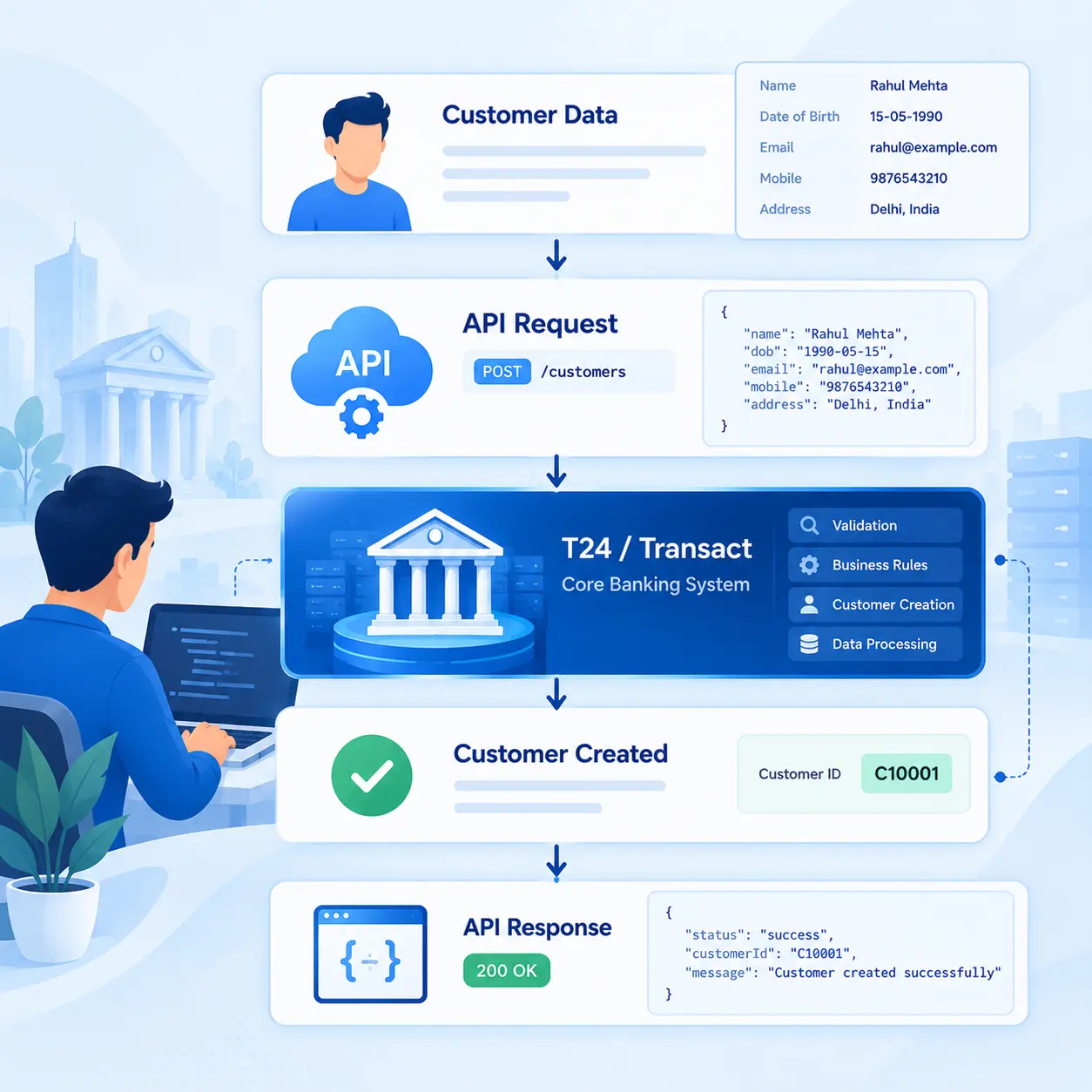
Project 1: Customer Creation
Build a workflow: Temenos provides an official quick-start example for creating a customer through its API ecosystem.
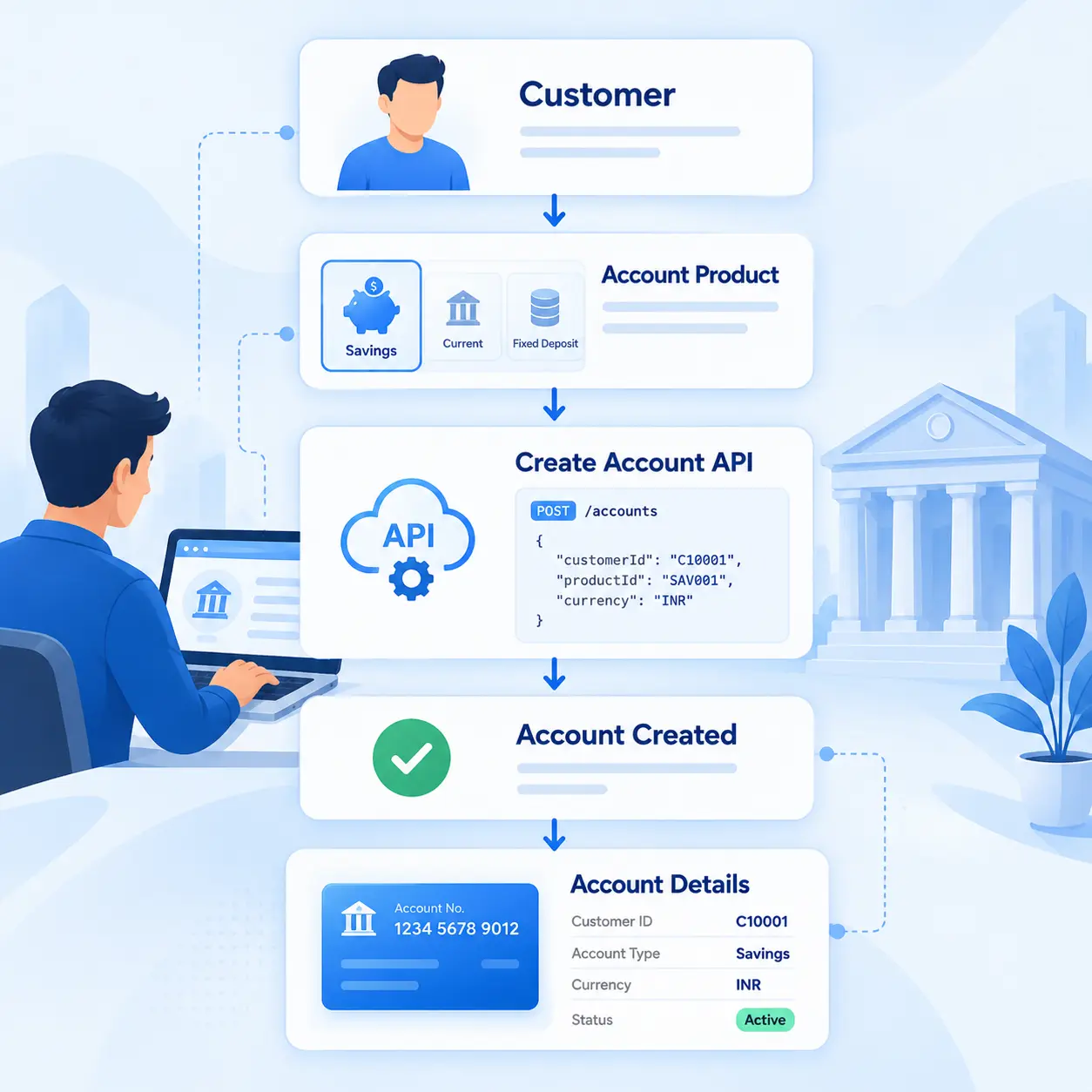
Project 2: Account Creation
Build: Temenos provides a current-account creation quick-start guide and examples for different account types.
Project 3: Account Information
Build a simple application that accepts a customer/account identifier, calls an API, retrieves account information, displays the response and handles errors. This teaches API integration.
Project 4: Fund Transfer
Create a conceptual flow: Customer → Mobile Banking → API → T24 → Balance Validation → Transaction Processing → Account Records → Response.
Test:
- Successful transfer
- Insufficient balance
- Invalid account
- Inactive account
- Invalid request
Project 5: End-to-End Banking Integration

This type of project gives you a much better understanding of enterprise banking architecture.
A Practical 2026 Learning Roadmap
Here's the sequence recommended for a beginner.
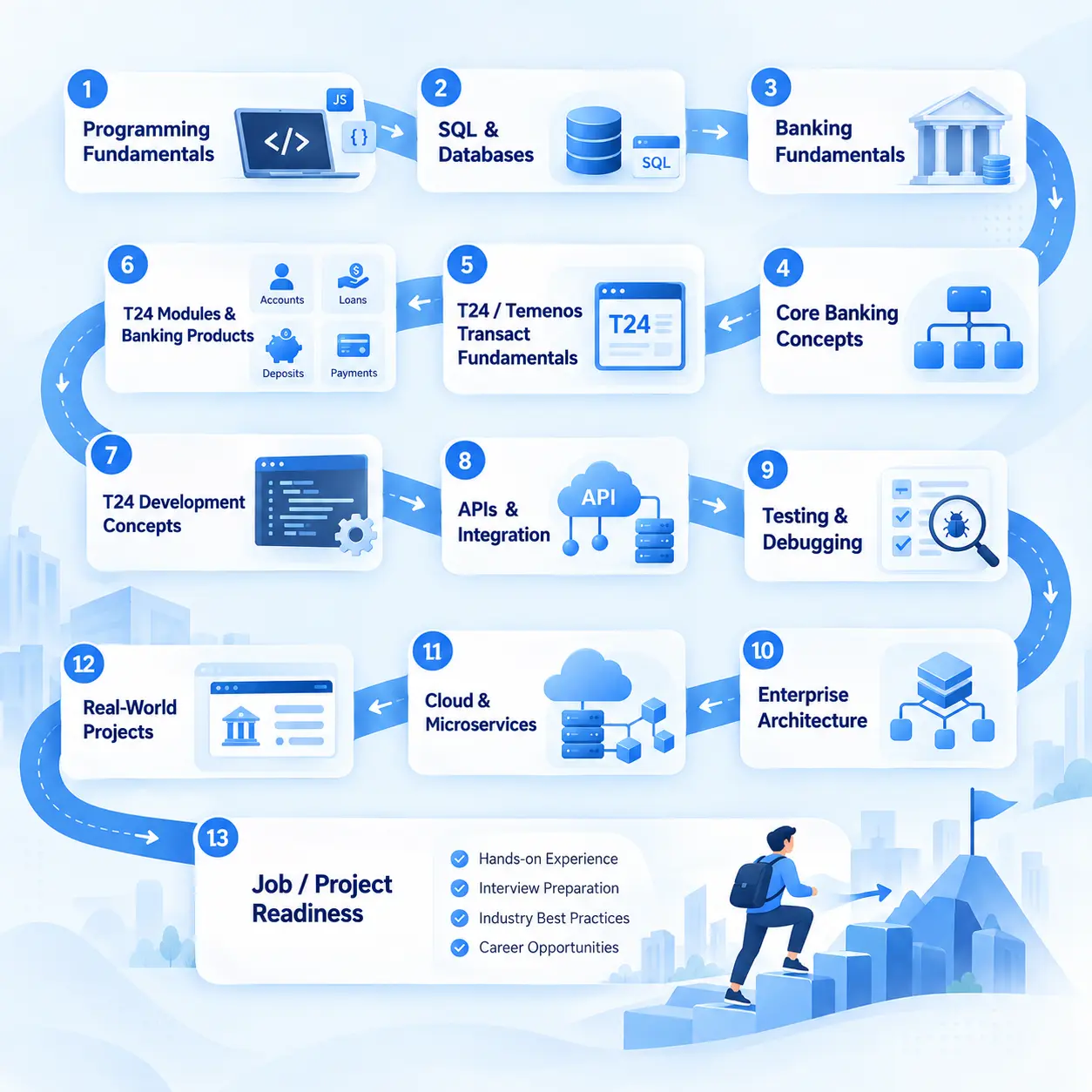
Don't treat this as a checklist that has to be completed sequentially without revisiting previous topics. Enterprise technology is interconnected.
For example, when learning account APIs, you may need to go back and learn more about banking accounts. When learning transaction testing, you may need to revisit banking business rules. That's normal.
What Programming Skills Should You Have?
There is no single "T24 programming language" that should be treated as the entire career foundation. Instead, focus on transferable technical skills.
Programming
- Variables
- Functions
- Conditions
- Loops
- Objects
- Error handling
- Debugging
SQL
- Queries
- Joins
- Transactions
- Data investigation
APIs
- REST
- JSON
- HTTP
- Authentication
- API testing
Web Technologies
Depending on the role, familiarity with HTML, CSS, JavaScript and TypeScript can be useful, particularly around modern developer tooling and interfaces. Temenos documentation for its Explorer framework, for example, lists HTML, CSS, JavaScript, TypeScript and custom elements among relevant developer skills.
Common Mistakes When Learning T24
1. Learning T24 Without Banking
This is probably the biggest mistake. You may understand the technical terminology without understanding what the system is actually doing.
2. Focusing Only on Screens
A developer needs to understand Requirement → Business Rule → Processing → Data → Integration, not simply Screen → Button → Result.
3. Ignoring APIs
Modern Temenos development has a strong API ecosystem. The official developer portal provides extensive Transact APIs and sandbox resources.
4. Ignoring Testing
Banking software requires careful testing of both successful and unsuccessful scenarios.
5. Trying to Learn Everything at Once
Don't start by trying to master T24, Java, SQL, APIs, AWS, Azure, Kubernetes, DevOps and microservices all at the same time. Build your foundation first.
6. Learning Only Theory
The fastest way to understand enterprise banking technology is to work through realistic scenarios.
How Long Does It Take to Become a T24 Developer?
There is no universal timeline. Your starting point matters. Someone who already knows programming, SQL, APIs and enterprise applications will have a different learning path from someone starting from zero. A reasonable progression is:
Beginner
Understand banking, core banking and T24 terminology.
Intermediate
Understand modules, APIs, SQL, integration and testing.
Job-Ready
- Explain banking workflows
- Understand T24 architecture
- Work with APIs
- Troubleshoot data
- Understand integration
- Test transactions
- Build practical scenarios
Advanced
Understand enterprise architecture, microservices, events, cloud, security, performance and production support.
The objective isn't to say "I completed T24 in three months." The better objective is: "I can understand a banking requirement and explain how it should be implemented and integrated into the core banking environment."
How to Become Job-Ready
Before applying for T24 development roles, make sure you can confidently explain the following.
Banking
- What is a savings account?
- How does a loan work?
- What is a deposit?
- What is a debit and credit?
- How does a payment work?
Core Banking
- What does a core banking system do?
- How does T24 fit into the architecture?
T24
- What is T24?
- What is Temenos Transact?
- What are the major banking areas?
- How are banking requirements represented?
Technical
- How do APIs work?
- How do you test an API?
- How do you investigate database data?
- How do systems integrate?
Testing
- How would you test a fund transfer?
- What negative scenarios would you test?
- How would you troubleshoot a failed transaction?
Architecture
- Where does T24 sit in a banking architecture?
- How does a mobile application communicate with the core?
- Where would an API gateway or integration layer fit?
If you can explain these concepts clearly and demonstrate practical scenarios, you're moving beyond beginner-level theoretical knowledge.
T24 Developer Interview Preparation
Once you've built your foundation, start preparing around three categories.
Banking Questions
- What is core banking?
- What is a savings account?
- What is a loan?
- What is a deposit?
- What is a transaction reversal?
T24 Questions
- What is T24?
- What is Temenos Transact?
- What are the major banking modules?
- How does T24 fit into a core banking architecture?
Technical Questions
- How would you integrate T24 with a mobile application?
- How would you test an account API?
- How would you troubleshoot a failed transaction?
- How would you investigate incorrect account data?
- How would you design an integration between T24 and another banking system?
The best preparation is not memorizing answers. Understand the underlying architecture so that you can explain your reasoning.
What Should You Learn After T24?
Once you are comfortable with T24, continue expanding your technical skills.
APIs
Deepen your REST and integration knowledge.
Microservices
Understand independently deployable services and distributed systems. Temenos' current Transact microservices documentation describes independently scalable services that can be developed and deployed separately.
Cloud
Learn AWS, Azure or GCP.
DevOps
- Git
- CI/CD
- Containers
- Monitoring
- Deployment automation
Events
Understand asynchronous communication and event-driven architecture.
Security
- IAM
- OAuth
- API security
- Encryption
- Audit trails
This turns a T24-focused developer into a broader enterprise technology professional.
Why Practical Training Matters
Core banking is difficult to learn purely from generic programming tutorials because the biggest challenge is often the combination of business and technology.
Consider a requirement such as: "A bank wants to introduce a new deposit product." A developer needs to think about:
Customer → Product → Eligibility → Account → Interest → Transactions → APIs → Financial Records → Testing
That's why practical training should ideally include:
- Banking concepts
- T24 fundamentals
- Realistic workflows
- APIs
- Integration
- Database concepts
- Testing
- Troubleshooting
- Enterprise architecture
The goal should be to understand how the pieces work together.
Frequently Asked Questions
How do I become a Temenos T24 developer in 2026?
Start with programming and SQL fundamentals, then learn banking concepts, core banking, T24/Temenos Transact, banking modules, APIs, integration, testing and enterprise architecture. Build practical banking scenarios using available developer resources and sandbox environments.
Is T24 still used in 2026?
T24 remains a commonly used industry term, while the current Temenos product terminology is Temenos Transact. Temenos continues to provide Transact APIs, developer resources and sandbox capabilities.
What skills are required for a T24 developer?
Useful skills include banking domain knowledge, programming fundamentals, SQL, APIs, integration, testing, debugging and enterprise architecture. Modern roles may also benefit from cloud, microservices, events and security knowledge.
Do I need banking experience to become a T24 developer?
No. Software developers can transition into T24 by learning banking fundamentals alongside the technical platform. However, understanding banking processes is essential for working effectively on core banking projects.
Is SQL required for T24 development?
SQL and database knowledge are highly useful for understanding and investigating enterprise banking data, although the exact database technologies and access patterns depend on the implementation.
Are APIs important for T24 developers?
Yes. Temenos provides extensive APIs for Transact, including capabilities around customers, accounts, payments, deposits, loans and other banking functions.
Can a Java or .NET developer become a T24 developer?
Yes. Existing software development skills provide a useful foundation. The developer will still need to learn banking concepts, T24/Transact, integration and the technologies used in the target implementation.
Is there a Temenos T24 developer sandbox?
Temenos provides a developer sandbox for experimenting with Transact APIs. Its documentation explains how to obtain an API key and use tools such as Postman to interact with the sandbox.
What should I learn first: T24 or banking?
Start with basic banking concepts, then core banking, and then move into T24. This makes the technical concepts considerably easier to understand.
Conclusion
Becoming a Temenos T24 developer in 2026 requires more than learning a banking software platform.
The strongest learning path combines:
Programming → SQL → Banking → Core Banking → T24/Temenos Transact → APIs → Integration → Testing → Architecture → Cloud
Start with the basics. Understand how a bank operates. Then understand how core banking supports those operations. After that, learn T24/Temenos Transact and gradually add APIs, databases, integration, testing and modern architecture.
Temenos' current developer ecosystem provides APIs, sandbox access, Postman collections, documentation and resources that allow developers to experiment with core banking capabilities in a practical environment.
The long-term goal shouldn't simply be to become someone who "knows T24." It should be to become a developer who understands banking requirements, core banking processes, technical implementation, integration and enterprise architecture.
That combination is what makes a T24 professional useful on real banking projects.
Want to go back to the basics first? Read What Is Temenos T24? A Beginner's Guide to Core Banking.
Learn Temenos T24 with Renu Sai Trainings
For professionals moving into banking technology, structured practical training can help connect software development skills with banking-domain knowledge.
Renu Sai's professional profile includes 12+ years of industry experience, corporate IT training, enterprise application development, cloud, DevOps, databases and software testing, along with Microsoft, AWS, Azure AI, ISTQB and Copado certifications.
A Temenos T24 training program can therefore be positioned around: banking fundamentals, T24/Transact, technical concepts, APIs, integration, testing and real-world banking scenarios.
Ready to build practical Temenos T24 skills?
I can design a training plan tailored to your goals—contact me to get started.
Let's turn learning into measurable business results.
Click to Connect now