What Is Temenos T24?
Introduction
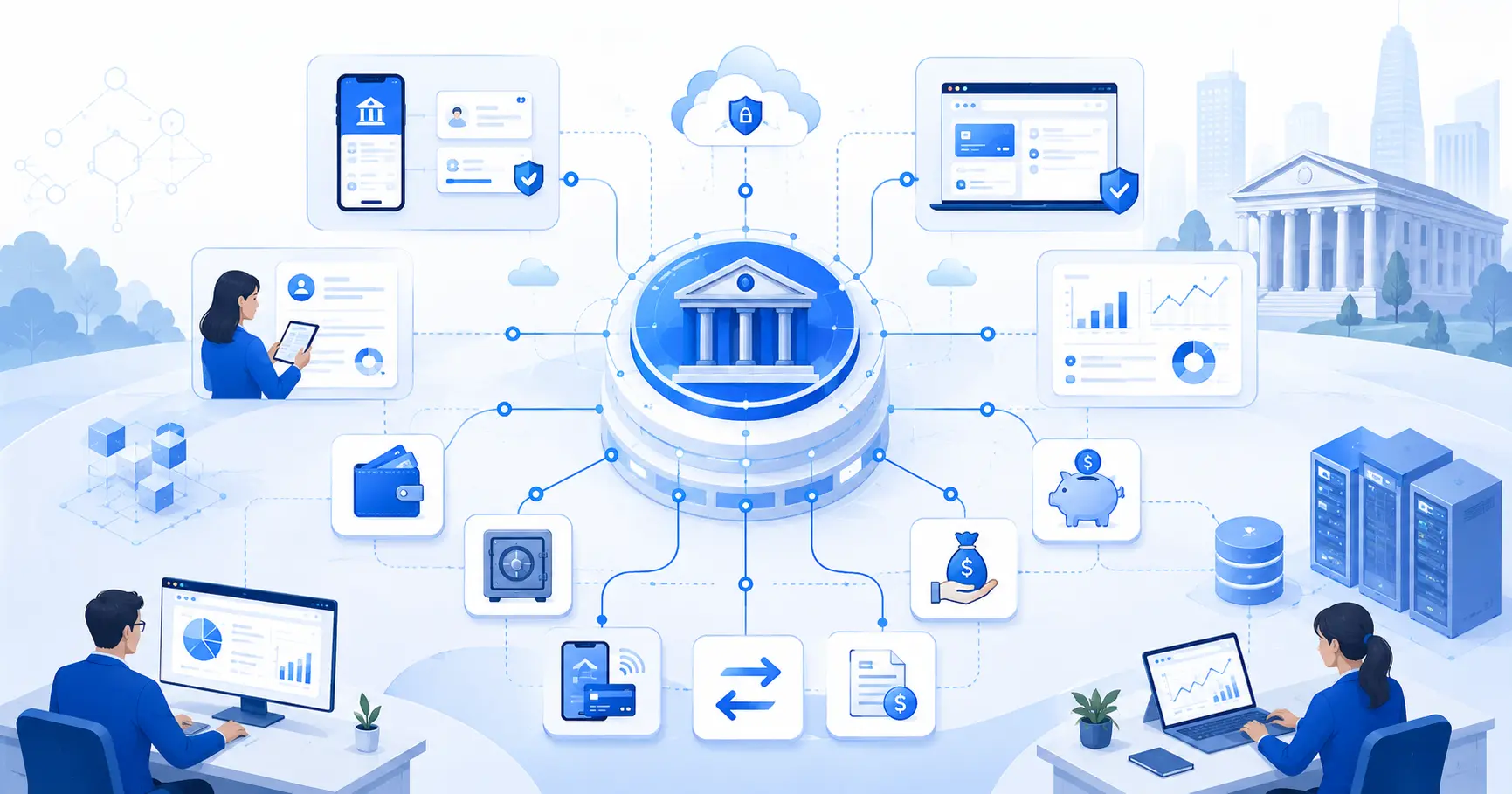
If you are new to banking technology, you may have heard terms such as Temenos T24, T24 core banking, Temenos Transact, or Temenos core banking and wondered what they actually mean.
In simple terms, Temenos T24 is a core banking software platform used by banks and financial institutions to manage essential banking operations such as customer accounts, deposits, loans, transactions, payments, and other financial services.
The product is now known as Temenos Transact, although T24 remains a very common term in the banking technology industry. Temenos explains that the name was changed from Temenos T24 Transact to Temenos Transact as the platform evolved toward a more modern, cloud-native, API-first and microservice-oriented architecture.
To understand T24, it helps to first understand what core banking actually means.
What Is Core Banking?
Core banking refers to the central systems and processes that allow a financial institution to manage its day-to-day banking operations.
These operations can include:
- Opening and managing customer accounts
- Processing deposits
- Processing withdrawals
- Managing loans
- Calculating interest
- Processing payments
- Maintaining customer information
- Managing banking products
- Recording financial transactions
- Supporting branch operations
- Connecting with external banking systems
Think of a bank as a large organization with thousands or millions of customers.
When a customer deposits money, takes a loan, transfers funds, or opens a savings account, the bank needs a central system to process and record those activities.
That central technology layer is the core banking system.
Temenos describes core banking as the centralized systems and processes that power activities such as accounts, deposits, loans, and transactions.
This is where Temenos T24 comes into the picture.
What Does Temenos T24 Do?
Temenos T24 provides the banking functionality required to manage financial products and transactions across different banking segments.
A simplified example would look like this:
Customer → Banking Channel → T24/Core Banking → Transaction Processing → Account/Financial Records
For example, imagine that a customer transfers ₹50,000 from one account to another.
The request might originate from:
- Mobile banking
- Internet banking
- ATM
- Branch
- Corporate banking application
- API-based application
The request can then reach the core banking platform, where the transaction is processed according to the bank's business rules.
The core system needs to determine:
- Who is the customer?
- Which account is involved?
- Is the account active?
- Is there sufficient balance?
- What transaction type is being performed?
- What fees or charges apply?
- What accounting entries should be generated?
- What should be returned to the requesting system?
This is why core banking systems are so important.
They are not simply databases storing account information. They contain business logic that supports the bank's financial operations.
Why Is T24 Called a Core Banking System?
The word "core" is important.
| Banking System | Purpose |
|---|---|
| Mobile Banking | Customer mobile experience |
| Internet Banking | Online banking |
| ATM System | Cash withdrawals and services |
| CRM | Customer relationship management |
| Payment System | Payment processing |
| Fraud System | Fraud monitoring |
| Data Warehouse | Reporting and analytics |
| Core Banking | Central banking operations |
The core banking platform sits at the center of many of these systems.
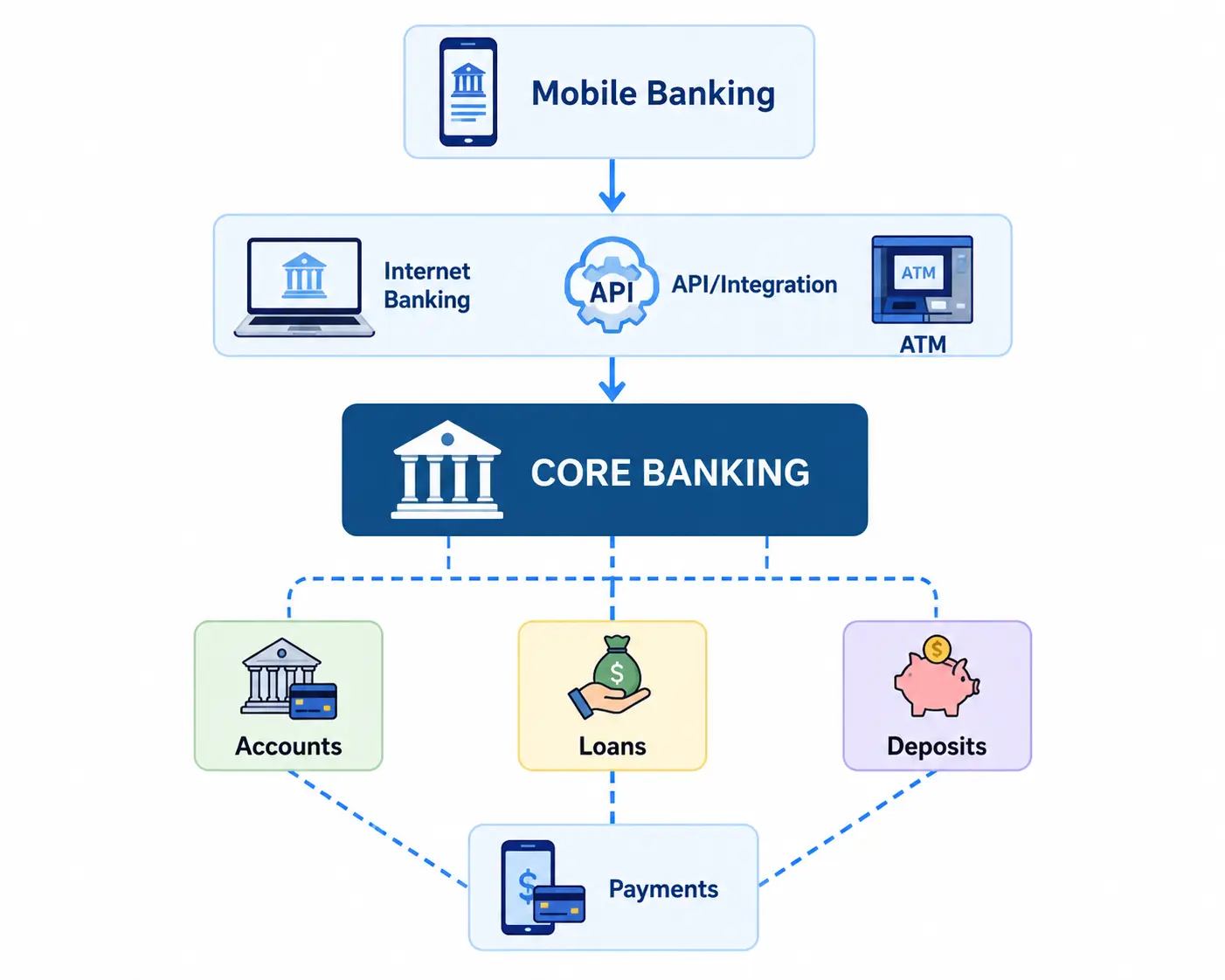
The exact architecture varies between banks, but the basic idea is that the core banking platform provides the central processing capabilities around which other banking applications operate.
Is T24 Still Called T24?
Yes, you will still hear T24 frequently in banking technology discussions, job descriptions, training programs, implementation projects, and among professionals who have worked with earlier versions of the platform.
However, the current product name is Temenos Transact.
Temenos officially announced the change from Temenos T24 Transact to Temenos Transact, explaining that the platform had evolved beyond the older integrated and monolithic implementation model toward microservice-based capabilities and newer deployment approaches.
Therefore, if you are searching for training or career opportunities, it is useful to understand all three terms:
- T24 – widely used industry/legacy name
- Temenos T24 Transact – historical product naming
- Temenos Transact – current product name
This distinction is particularly important for beginners because older documentation and job descriptions may still use "T24".
Major Functional Areas in T24
T24 supports a broad range of banking functionality.
The exact modules and configuration depend on the implementation and banking segment, but common areas include the following.
1. Customer Management
Banks need to maintain information about customers and their relationships with the institution.
Customer-related information can include:
- Customer identity
- Contact information
- Customer type
- Relationships
- Addresses
- Identification information
- Account relationships
A customer may have multiple products with the same bank.
For example:
Customer → Savings Account + Credit Card + Home Loan + Fixed Deposit
The core banking system needs to maintain these relationships.
2. Accounts
Account management is one of the fundamental areas of core banking.
Banks may manage:
- Savings accounts
- Current accounts
- Deposit accounts
- Corporate accounts
- Specialized financial accounts
The system tracks transactions and maintains account balances according to configured banking rules.
3. Deposits
Banks manage different types of deposit products.
Examples include:
- Savings deposits
- Term deposits
- Fixed deposits
- Recurring deposits
The system may need to calculate:
- Interest
- Maturity
- Charges
- Renewals
- Early withdrawal rules
4. Loans
Loan management is another important area of core banking.
A bank may offer:
- Personal loans
- Home loans
- Vehicle loans
- Business loans
- Corporate loans
A core banking system can support processes such as:
- Loan account creation
- Interest calculation
- Repayment schedules
- Installments
- Fees
- Outstanding balances
- Loan closure
5. Payments and Transactions
Banks process thousands or millions of transactions.
These can include:
- Account transfers
- Deposits
- Withdrawals
- Payments
- Standing instructions
- Internal transfers
- External transfers
The core banking system must process these transactions accurately while maintaining financial records.
How Does T24 Work?
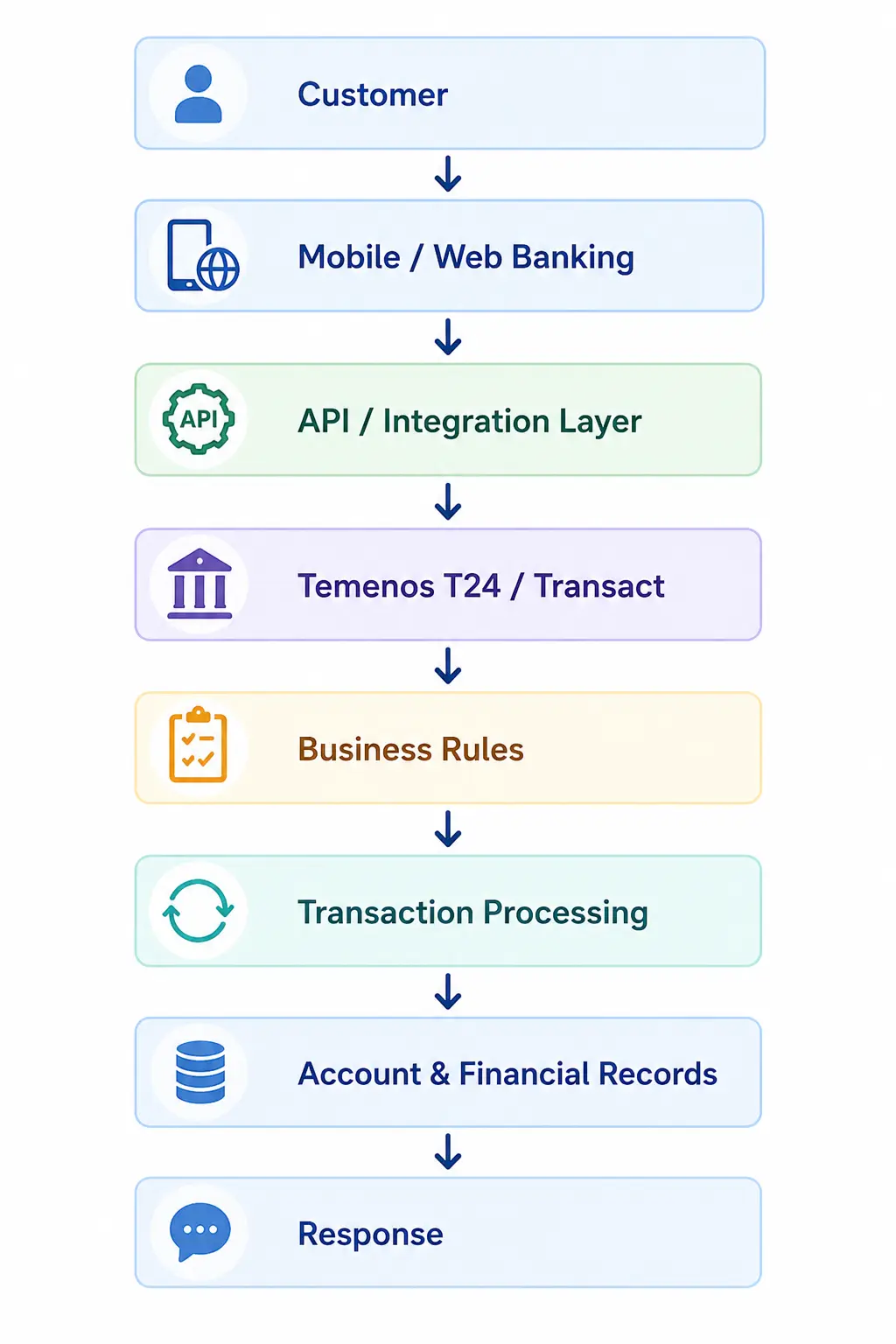
At a high level, a banking transaction passes through multiple layers.
Consider a simple fund transfer.
Step 1: Customer Initiates Transaction
The customer initiates a transfer using mobile banking.
Step 2: Digital Banking Application
The mobile application sends the request to the bank's backend services.
Step 3: Integration Layer
The request is routed through the bank's integration/API infrastructure.
Step 4: Core Banking
T24/Temenos Transact receives and processes the transaction.
Step 5: Business Rules
The system checks relevant conditions such as account status, available balance, product rules, fees, limits, and transaction requirements.
Step 6: Transaction Processing
The appropriate financial entries are generated.
Step 7: Response
The result is returned to the requesting application.
Modern Temenos architecture also emphasizes APIs and integration capabilities. Temenos currently describes its core banking platform as cloud-native, cloud-agnostic and API-first, with extensive Open APIs for integration.
What Is T24 Architecture?
A beginner should think about T24 architecture in terms of several logical layers rather than trying to understand every technical component immediately.
A simplified model is:
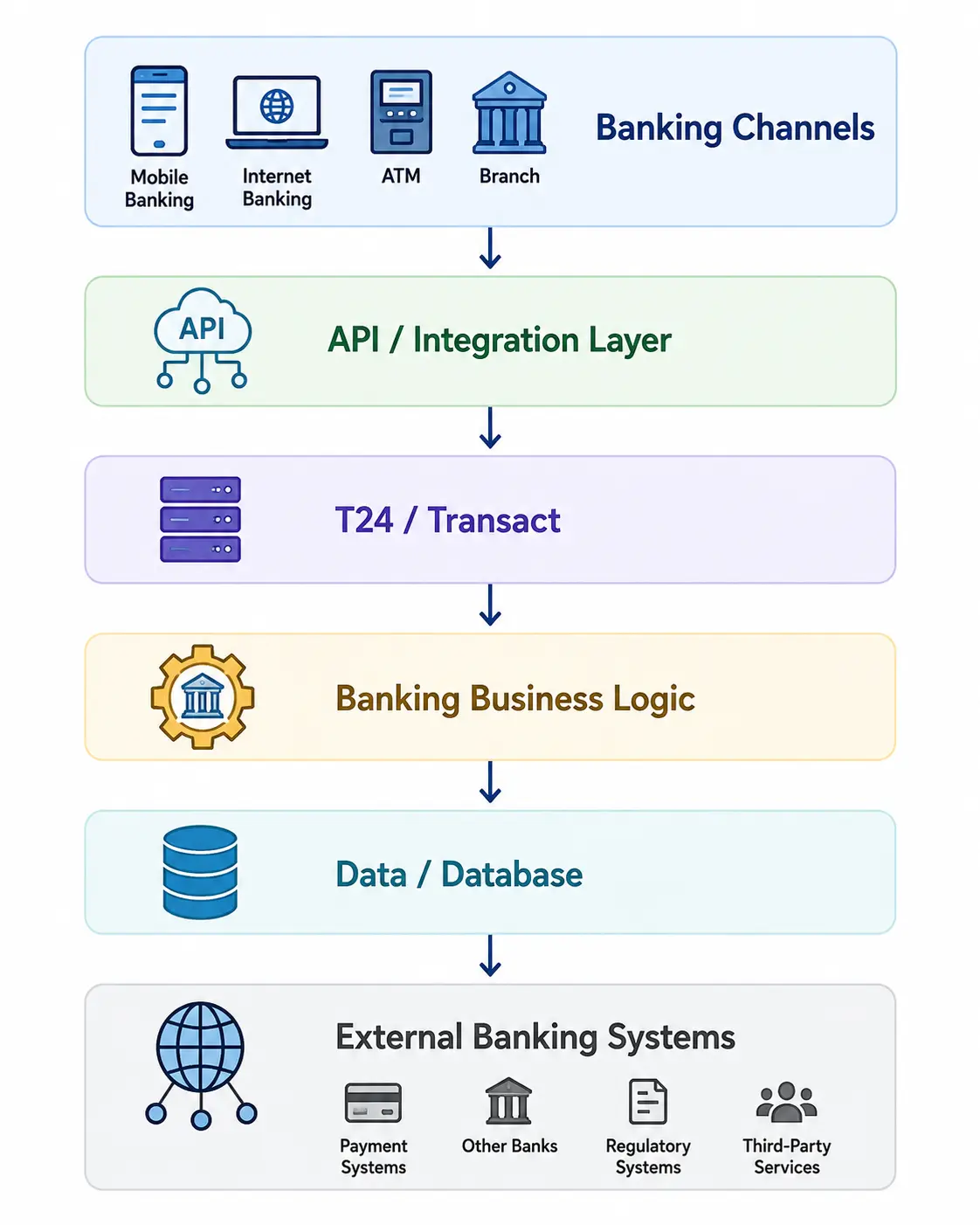
In a real enterprise implementation, the architecture can be much more sophisticated.
It may include:
- Digital channels
- API gateways
- Integration platforms
- Core banking services
- Databases
- Payment systems
- Authentication services
- Reporting platforms
- Fraud systems
- Data platforms
- External financial networks
The architecture also depends on the bank's deployment strategy and modernization requirements.
T24 and APIs
Modern banking environments rarely operate as isolated systems.
Banks need to connect their core banking platform with:
- Mobile applications
- Internet banking
- Payment gateways
- CRM systems
- Fraud detection systems
- Data platforms
- Fintech applications
- Government systems
- Regulatory platforms
- Third-party services
This is where APIs become important.
Temenos provides Core Banking APIs designed to expose banking functionality to other applications and systems. Its developer platform describes these APIs as consumable through the Temenos Core Banking platform.
For example:
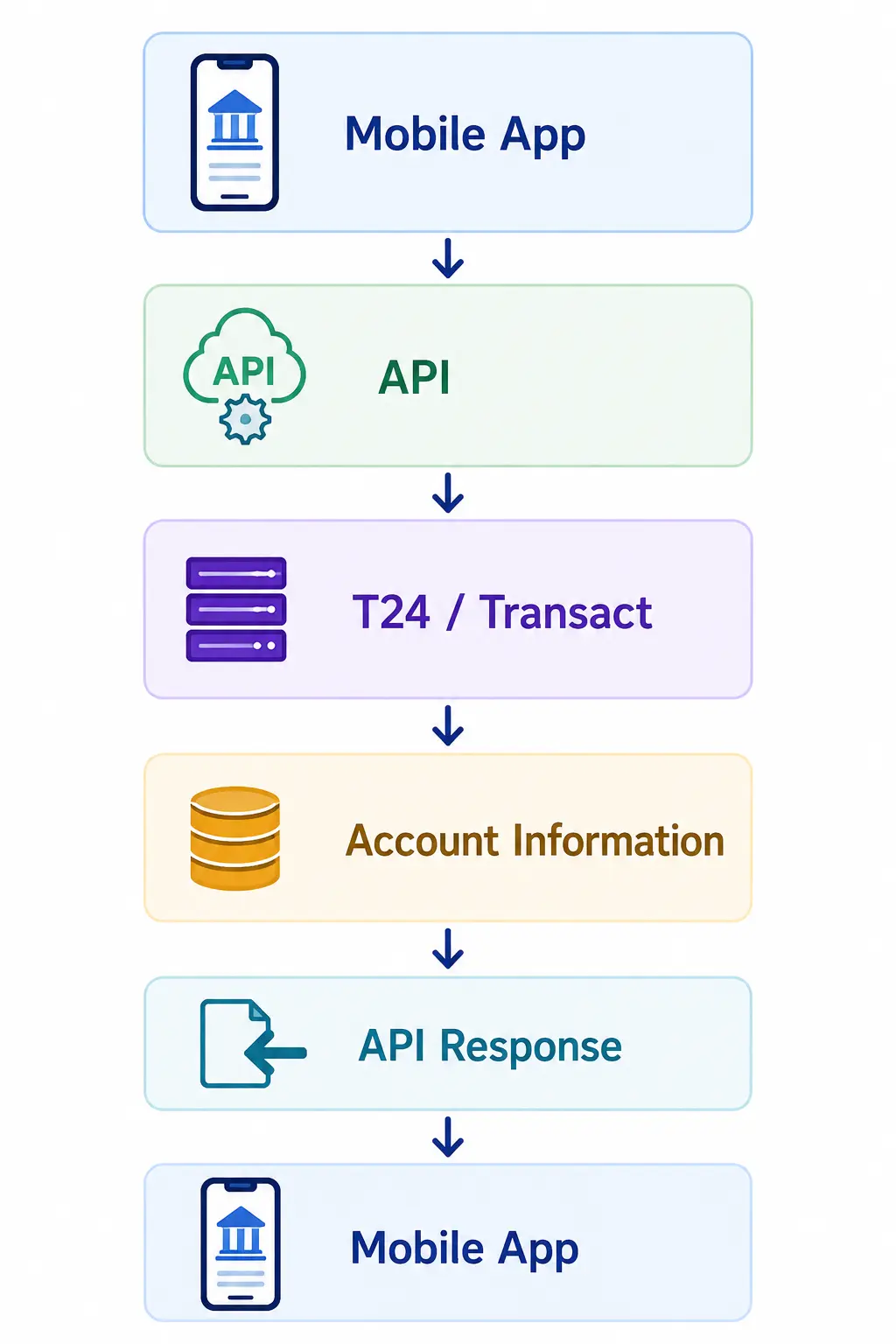
This approach allows modern digital channels to interact with core banking capabilities without directly implementing the underlying banking logic themselves.
T24 and Digital Banking
It is important to understand that core banking and digital banking are not the same thing.
Digital banking focuses heavily on customer-facing experiences.
Examples include:
- Mobile banking
- Internet banking
- Digital onboarding
- Customer dashboards
- Digital payments
- Self-service banking
Core banking handles the underlying financial processing.
A simplified relationship looks like this:
Customer → Digital Banking → Core Banking → Accounts / Loans / Deposits / Transactions
Temenos provides both core banking and digital banking capabilities as part of its broader banking platform ecosystem.
Why Do Banks Use T24?
There are several reasons financial institutions adopt enterprise core banking platforms.
Scalability
Large financial institutions need systems capable of processing significant transaction volumes.
Configurability
Banking products differ between institutions and countries.
Banks need to configure products, rules, charges, interest calculations, and processes according to their business requirements.
Integration
Core banking systems need to communicate with many surrounding applications.
Product Support
Banks require functionality across areas such as retail, business, corporate, treasury, payments, and other financial services.
Modernization
Banks increasingly need to modernize legacy infrastructure while maintaining critical banking operations.
Temenos currently describes its Core platform as supporting banking across multiple segments and says it is used by more than 950 banks globally.
T24 vs Traditional Legacy Core Banking
Traditional banking environments often evolved over decades.
A bank may have:
- Mainframe applications
- Custom-developed applications
- Separate databases
- Batch processing
- Point-to-point integrations
- Older middleware
- Manual processes
Modern core banking platforms aim to provide more flexible and integrated architectures.
A simplified comparison:
| Area | Traditional Legacy Environment | Modern Core Banking |
| Architecture | Often tightly coupled | More modular |
| Integration | Point-to-point | API-driven |
| Deployment | Primarily on-premise | Cloud, SaaS or on-premise |
| Scalability | More difficult | Designed for elastic scaling |
| Innovation | Slower | Faster |
| Upgrades | Complex | More continuous/modular |
| Digital Integration | Often difficult | API-enabled |
The transition is not simply about replacing old software. Banks need to consider data migration, integrations, regulatory requirements, testing, operational continuity, and employee skills.
Is T24 a Programming Language?
No.
This is a common misunderstanding among beginners.
T24 is a banking software platform, not a programming language.
Professionals working with T24 may use or encounter different technologies, tools, scripting approaches, APIs, databases, integration technologies, and development frameworks depending on the implementation.
A better approach is to identify the role you want to pursue:
- T24 Developer
- T24 Technical Consultant
- T24 Functional Consultant
- T24 Support Engineer
- Core Banking Integration Developer
- Temenos Transact Consultant
- Banking Application Tester
Each role requires a different skill set.
T24 Functional vs Technical Roles
This distinction is particularly important for beginners.
T24 Functional Consultant
A functional professional focuses more on:
- Banking processes
- Product configuration
- Business requirements
- Banking workflows
- Functional specifications
- User requirements
- Testing
- Client communication
T24 Technical Developer
A technical professional focuses more on:
- Development
- Customization
- APIs
- Integration
- Data
- Technical configuration
- Troubleshooting
- Deployment
- Performance
They generally require stronger programming and technical skills.
What Skills Are Useful for a T24 Career?
If you're planning to work with T24 or Temenos Transact, don't focus only on the product.
A strong professional should understand both technology and banking.
Banking Knowledge
Learn:
- Accounts
- Deposits
- Loans
- Payments
- Interest
- Customers
- Branch banking
- Transaction processing
- Banking terminology
Technical Knowledge
Depending on the role, useful areas can include:
- Programming fundamentals
- Databases
- APIs
- REST
- Integration
- XML/JSON
- SQL
- Testing
- DevOps
- Cloud concepts
T24 Knowledge
Then build knowledge of:
- T24 architecture
- Modules
- Banking products
- Transactions
- APIs
- Configuration
- Customization
- Integration
- Testing
- Production support
This combination makes a professional much more useful than someone who knows only the software interface.
Why Is T24 Training Important?
Core banking systems are enterprise platforms.
Learning them only through theoretical definitions is usually not enough.
Professionals need to understand how banking requirements translate into system behavior.
For example:
Business Requirement:
"The bank wants to introduce a savings account with a specific interest calculation and minimum balance requirement."
A T24 professional needs to understand:
- What banking product is required?
- What rules apply?
- How should interest be calculated?
- What happens when the minimum balance is not maintained?
- What transactions are allowed?
- Which systems need to integrate with the product?
- How should the feature be tested?
- What happens during production processing?
This is why practical, scenario-based training can be more valuable than memorizing terminology.
Common Challenges in T24 Projects
Implementing or maintaining a core banking platform is not simple.
Common challenges include:
Data Migration
Moving customer, account, transaction, and product data from an existing system requires careful planning and validation.
Integration
Core banking platforms need to communicate with many internal and external systems.
Customization
Banks often have unique business requirements.
Testing
A small error in financial transaction processing can have significant consequences.
Testing may include:
- Functional testing
- Integration testing
- Regression testing
- API testing
- Performance testing
- Data validation
- User acceptance testing
Regulatory Requirements
Banking systems operate under strict regulatory and compliance requirements.
Production Support
Core banking systems are business-critical. Downtime or incorrect processing can directly affect customers and financial operations.
T24 in Modern Banking Transformation
The banking industry is moving toward:
- Cloud computing
- APIs
- Microservices
- Open banking
- Real-time processing
- AI
- Automation
- Data analytics
- Digital banking
- Embedded finance
This does not mean that traditional core banking knowledge suddenly becomes irrelevant.
Instead, the role of core banking is evolving.
Temenos has described its modern platform direction as cloud-native, cloud-agnostic and API-first, while also emphasizing modularity and microservice-based approaches.
This means professionals working with T24 increasingly need to understand both traditional banking systems and modern technology architecture.
T24 and FIS, Finacle, and Other Core Banking Platforms
T24 is one of several enterprise core banking platforms.
Banks may also use solutions from other vendors, such as:
- Oracle
- Infosys Finacle
- FIS
- Jack Henry
- Other specialized banking technology providers
The important thing is to understand the underlying problem these platforms solve.
Regardless of the vendor, a core banking system generally needs to support:
Customers → Products → Accounts → Transactions → Financial Processing
The technologies and implementation approaches differ, but the banking fundamentals remain important.
Who Should Learn Temenos T24?
T24 can be particularly relevant for:
- Banking IT professionals
- Software developers
- Business analysts
- QA engineers
- Integration developers
- Technical consultants
- Functional consultants
- Solution architects
- Banking domain professionals
- Professionals moving into fintech
- Fresh graduates interested in banking technology
It can also be useful for experienced software professionals who want to move from general IT development into the financial services domain.
Beginner's Roadmap to Learning T24
If you're starting from zero, don't try to learn everything simultaneously.
A practical sequence would be:
Step 1: Learn Banking FundamentalsUnderstand:
- Accounts
- Customers
- Deposits
- Loans
- Payments
- Interest
- Transactions
Learn how a bank's central processing system works.
Step 3: Learn T24 ConceptsUnderstand the platform, terminology, modules, products, and workflows.
Step 4: Learn Technical ConceptsDepending on your career path, study:
- APIs
- Databases
- Integration
- Development
- Testing
For example:
Create a customer → open an account → perform a transaction → generate a transaction result → integrate the transaction with another banking system.
Step 6: Learn Enterprise IntegrationUnderstand how T24 interacts with:
- Digital banking
- Payment systems
- CRM
- Reporting
- External APIs
- Other enterprise applications
Practice identifying:
- Invalid transactions
- Integration failures
- Data issues
- Configuration errors
- API errors
Frequently Asked Questions About Temenos T24
What is Temenos T24?
Temenos T24 is a core banking software platform used by financial institutions to manage banking operations such as accounts, deposits, loans, transactions, and financial products. The product is now known as Temenos Transact.
Is T24 and Temenos Transact the same?
T24 is the commonly used historical name associated with the product. Temenos changed the product name from Temenos T24 Transact to Temenos Transact as the platform evolved.
Is T24 a programming language?
No. T24 is a core banking software platform. Professionals working with it may use different programming, integration, API, database, testing, and configuration technologies depending on their role.
What does T24 do in a bank?
T24 can support core banking operations such as customer and account management, deposits, loans, transactions, payments, and other financial services.
Is T24 still used by banks?
Yes. T24 remains a widely recognized term in the banking technology industry, while the current Temenos product branding is Temenos Transact. Temenos currently states that more than 950 banks use its Core platform.
Is T24 difficult to learn?
The difficulty depends on your background and target role. Someone with banking domain knowledge may find the functional concepts easier, while developers may need additional learning around banking processes, APIs, integration, configuration, and enterprise architecture.
What should I learn before T24?
Start with banking fundamentals and core banking concepts. Then learn T24/Temenos Transact concepts, followed by the technical skills relevant to your chosen role, such as APIs, databases, integration, development, or testing.
Is T24 useful for a banking IT career?
Yes. Core banking knowledge can be valuable for professionals working in banking software, fintech, financial services consulting, testing, integration, development, and enterprise technology.
Conclusion
Temenos T24 is best understood as a core banking platform rather than simply another banking application.
It sits close to the heart of banking operations, helping financial institutions manage customers, accounts, deposits, loans, transactions, products, and other critical processes.
Although the product is now known as Temenos Transact, the term T24 remains widely recognized across the banking technology ecosystem.
For beginners, the most important thing is not to start by memorizing technical terminology. Start by understanding how a bank works.
Learn:
Banking → Core Banking → T24 Concepts → Technical Architecture → Integration → Real-World Scenarios
Once these pieces come together, T24 becomes much easier to understand.
For IT professionals looking to move into banking technology, learning Temenos T24 alongside programming, databases, APIs, integration, testing, and banking domain knowledge can provide a strong foundation for working on enterprise core banking projects.
Learn Temenos T24 with Renu Sai Trainings
For professionals who want to move beyond theory, practical training can help connect banking concepts with real enterprise technology scenarios.
Renu Sai's professional profile combines 12+ years of industry experience with software development, corporate training, enterprise application development, cloud, testing, and multiple Microsoft/AWS/ISTQB certifications. The technical background also includes Java, C#, SQL, APIs, cloud, DevOps, and software testing.
A practical Temenos T24 Training program can therefore be positioned around understanding both the banking domain and the technology involved in enterprise banking applications.
Want help choosing a learning path?
I can design a training plan tailored to your goals—contact me to get started.
Let's turn learning into measurable business results.
Click to Connect now