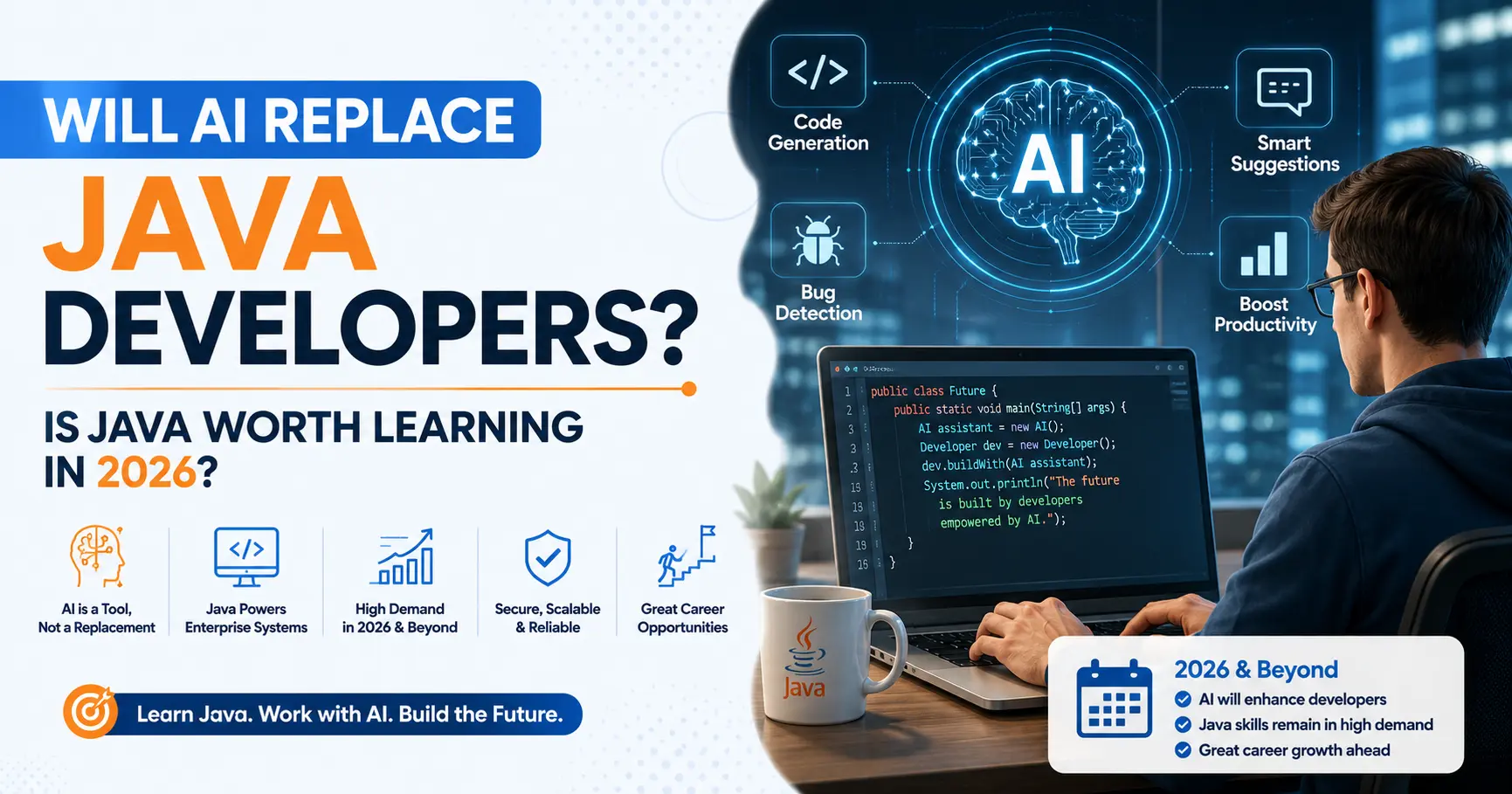
Will AI Replace Java Developers? Is Java Worth Learning in 2026?
Introduction
Over the last two years, Artificial Intelligence has changed the way software is built. Tools like GitHub Copilot, ChatGPT, Claude, Gemini, and Cursor AI can write code, explain errors, generate unit tests, and even build complete applications from simple prompts.
Because of this, one question keeps coming up among students and developers:
Will AI replace Java developers?
Another common question is:
Should I learn Java in 2026, or is it becoming obsolete?
The short answer is No.
AI is changing the way Java developers work, but it is not replacing experienced software engineers. In fact, developers who know Java and understand how to use AI effectively are becoming even more valuable.
Let's explore why.
Why People Think AI Will Replace Java Developers
Modern AI tools are incredibly impressive.
Today they can:
- Generate Java code
- Explain complex algorithms
- Create REST APIs
- Write unit tests
- Suggest bug fixes
- Generate documentation
- Refactor existing code
Seeing these capabilities, many beginners assume companies will stop hiring Java developers altogether.
However, software development involves much more than writing code.
Professional developers spend a significant amount of their time understanding business requirements, designing scalable systems, reviewing code, optimizing performance, securing applications, and collaborating with teams. These are areas where human expertise remains essential.
What AI Can Do Well
Artificial Intelligence is excellent at assisting developers with repetitive and time-consuming tasks.
Some examples include:
- Writing boilerplate Java code
- Creating CRUD APIs
- Generating documentation
- Writing SQL queries
- Suggesting unit tests
- Explaining existing code
- Detecting common bugs
- Improving code readability
These capabilities make developers more productive rather than replacing them.
Think of AI as a highly skilled coding assistant—not a software architect.
What AI Still Cannot Replace
Even the most advanced AI models struggle with many real-world software engineering challenges.
For example:
Understanding Business Requirements
Clients rarely describe exactly what they need.
Developers ask questions, clarify requirements, and translate business problems into technical solutions.
AI cannot independently conduct stakeholder discussions or understand organizational priorities.
Software Architecture
Designing enterprise Java applications requires experience.
Developers must decide:
- Should we use Microservices or a Monolith?
- Which database is appropriate?
- How should caching work?
- How should authentication be implemented?
- How should services communicate?
These architectural decisions require trade-offs that depend on business goals, budgets, scalability, and security.
Debugging Production Systems
Production issues are rarely straightforward.
A slow application may involve:
- Database bottlenecks
- Network latency
- JVM tuning
- Memory leaks
- Cloud infrastructure
- Third-party APIs
Finding the root cause requires investigation and experience that AI alone cannot provide.
Communication and Collaboration
Software is built by teams.
Developers regularly collaborate with:
- Product Managers
- QA Engineers
- UI/UX Designers
- DevOps Engineers
- Clients
- Business Analysts
Strong communication skills remain one of the biggest advantages human developers have over AI.
Will AI Replace Java Developers?
The honest answer is:
No—but it will replace developers who refuse to adapt.
Companies are increasingly looking for developers who know how to use AI tools effectively.
Instead of replacing Java developers, AI is changing the expectations.
Modern developers are expected to:
- Write clean Java code
- Build scalable applications
- Use AI to improve productivity
- Review AI-generated code
- Ensure security and maintainability
Developers who combine Java expertise with AI skills will have a significant advantage in the job market.
Should I Learn Java in 2026?
Absolutely.
Java continues to be one of the most widely used programming languages for enterprise software development.
Large organizations across banking, healthcare, insurance, retail, manufacturing, and government continue to rely on Java for mission-critical systems.
Many of these applications have been running successfully for years and require skilled developers for maintenance, modernization, and new feature development.
Why Java Still Has a Strong Future
Java remains relevant because of its stability, scalability, and mature ecosystem.
Some of the technologies keeping Java in high demand include:
- Spring Boot
- Spring Security
- Hibernate
- Jakarta EE
- Apache Kafka
- Docker
- Kubernetes
- Microservices
- REST APIs
- Cloud-native development
Java also continues to evolve with regular language improvements, performance enhancements, and modern development features.
What Is the Future of Java Developers?
The future looks promising—but the role is evolving.
Tomorrow's Java developers won't just write backend code.
They'll also:
- Build AI-powered applications
- Integrate Large Language Models (LLMs)
- Develop intelligent APIs
- Work with cloud platforms
- Automate development workflows
- Build Microservices
- Deploy applications using Kubernetes
- Use AI-assisted coding tools
Java developers who embrace these technologies will continue to be in high demand.
Why Enterprise Companies Still Invest in Java
One of the biggest reasons Java continues to thrive is its strong presence in enterprise software development.
Large organizations prioritize stability, security, scalability, and long-term maintainability over simply adopting the newest programming language.
Java has consistently delivered on these requirements for decades, making it the preferred choice for business-critical applications.
Today, many of the world's largest organizations continue to build and maintain their core systems using Java because of its mature ecosystem, extensive library support, and ability to handle applications that serve millions of users.
This ongoing enterprise adoption ensures a steady demand for skilled Java developers across industries.
How AI Is Making Java Developers More Productive
Rather than replacing developers, AI is helping them work smarter.
Modern AI tools can generate boilerplate code, explain unfamiliar APIs, suggest performance improvements, and even identify potential bugs before code reaches production.
This allows developers to spend more time solving business problems instead of writing repetitive code.
For experienced Java developers, AI becomes a productivity multiplier rather than a competitor.
The best Java developers of 2026 won't compete with AI—they'll know how to collaborate with it.
Skills Every Java Developer Should Learn in 2026
To stay competitive, focus on developing skills beyond the Java language itself.
Recommended technologies include:
Core Skills
- Core Java
- Object-Oriented Programming
- Collections Framework
- Multithreading
- JVM Fundamentals
Backend Development
- Spring Boot
- Spring Security
- Hibernate
- REST APIs
- GraphQL
Cloud & DevOps
- Docker
- Kubernetes
- Git
- CI/CD
- AWS or Azure
AI Integration
- OpenAI APIs
- AI-assisted development
- Prompt Engineering
- LLM Integration
- Retrieval-Augmented Generation (RAG)
Developers who combine Java with AI will be among the most sought-after professionals over the coming years.
Final Verdict
So, will AI replace Java developers?
No.
AI will automate repetitive coding tasks, improve developer productivity, and change how software is built—but it cannot replace experienced engineers who understand architecture, business requirements, system design, and problem-solving.
If you're wondering whether Java is worth learning in 2026, the answer is a clear yes.
Java remains one of the strongest career choices for enterprise software development, and developers who learn Java alongside AI technologies will be well-positioned for the future.
Rather than competing with AI, the smartest strategy is to learn how to work with it.
The future doesn't belong to developers who fear AI.
It belongs to developers who know how to use AI to build better software.
Frequently Asked Questions
Will AI replace Java developers completely?
No. AI can automate repetitive coding tasks, but software architecture, business analysis, debugging, and enterprise system design still require experienced Java developers.
Is Java worth learning in 2026?
Yes. Java continues to be one of the most widely used programming languages for enterprise software, cloud applications, backend systems, and Microservices.
What is the future of Java developers?
The future is strong for developers who combine Java expertise with AI, cloud computing, DevOps, and modern backend technologies like Spring Boot and Kubernetes.
Can AI write Java code?
Yes. AI tools can generate Java code, suggest improvements, and help with debugging. However, developers are still responsible for validating, securing, optimizing, and maintaining production-ready applications.
Should beginners learn Java or AI first?
Start with Java to build strong programming fundamentals. Once you're comfortable with software development concepts, learn AI tools and techniques to improve your productivity and expand your career opportunities.
Conclusion
Artificial Intelligence is transforming software development, but it is not eliminating the need for skilled Java developers. Instead, it is reshaping the profession by automating repetitive work and enabling developers to focus on higher-value tasks such as architecture, problem-solving, performance optimization, and innovation.
Java continues to power enterprise applications across industries, making it one of the safest and most rewarding programming languages to learn in 2026. Organizations are looking for developers who not only understand Java but can also leverage AI to build smarter, faster, and more scalable solutions.
Whether you're a student starting your programming journey or an experienced developer looking to future-proof your career, investing in Java alongside AI technologies is one of the smartest decisions you can make.
Learn Java. Embrace AI. Build the future.
Want help choosing a learning path?
I can design a training plan tailored to your goals—contact me to get started.
Let's turn learning into measurable business results.
Click to Connect now