What Is HL7 and Why Is It Important in Healthcare?
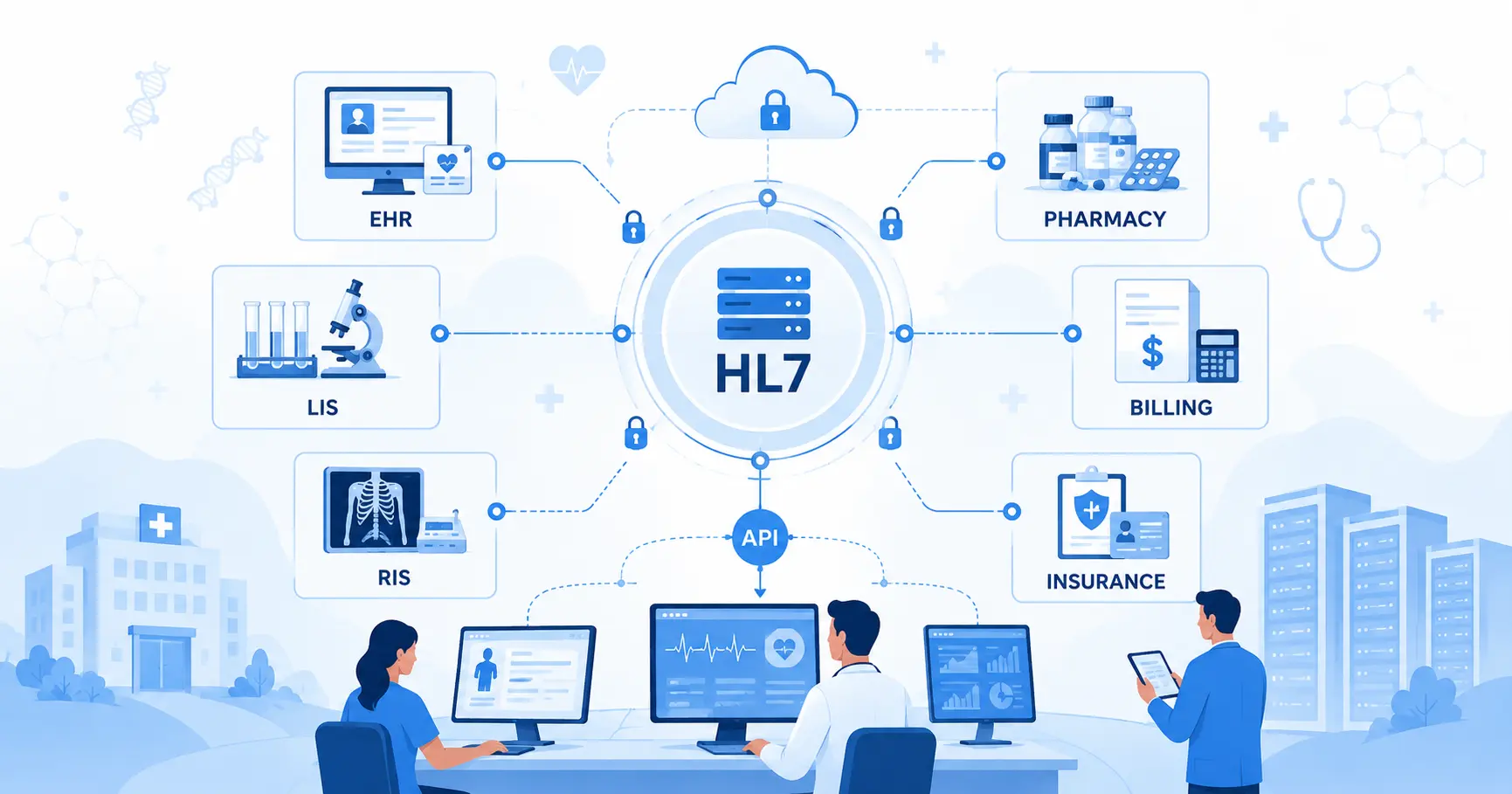
Introduction
Healthcare organizations today rely on dozens of software applications to manage patient care, laboratory results, billing, radiology, pharmacy, insurance claims, and much more. However, these systems are often developed by different vendors and use different data formats, making seamless communication a challenge.
Imagine a patient visiting a hospital where the doctor, laboratory, pharmacy, and billing department each use different software. Without a common communication standard, patient information would need to be entered manually into every system, increasing the risk of errors, delays, and duplicated work.
This is exactly the problem that HL7 (Health Level Seven) was designed to solve.
HL7 provides a standardized framework that enables healthcare systems to exchange clinical and administrative information accurately, securely, and efficiently. Today, it is one of the most widely adopted healthcare interoperability standards worldwide and plays a critical role in digital healthcare transformation.
In this guide, you'll learn what HL7 is, how it works, why it matters, and why healthcare professionals and organizations continue to invest in HL7 expertise.
Table of Contents
- What Is HL7?
- Why Was HL7 Created?
- Understanding Healthcare Interoperability
- How HL7 Works
- Common HL7 Message Types
- HL7 Standards Explained
- HL7 Version 2 vs Version 3 vs FHIR
- Benefits of HL7
- Real-World Applications of HL7
- Challenges of HL7 Implementation
- Future of HL7
- Who Should Learn HL7?
- FAQs
- Conclusion
What Is HL7?
HL7 stands for Health Level Seven, a set of international standards developed to facilitate the electronic exchange of healthcare information.
The "Level Seven" refers to Layer 7 (Application Layer) of the OSI networking model, where applications communicate with each other.
Rather than being a programming language or software application, HL7 is a communication standard that defines how healthcare information should be structured, formatted, and transmitted between systems.
These systems include:
- Electronic Health Record (EHR) systems
- Hospital Information Systems (HIS)
- Laboratory Information Systems (LIS)
- Radiology Information Systems (RIS)
- Pharmacy Management Systems
- Insurance Platforms
- Billing Systems
- Medical Devices
Without HL7, each software vendor would create proprietary communication methods, making healthcare integration nearly impossible.
Why Was HL7 Created?
Healthcare organizations use software from multiple vendors.
For example:
| Department | Software |
|---|---|
| Registration | Hospital Information System |
| Laboratory | Laboratory Information System |
| Radiology | Radiology Information System |
| Pharmacy | Pharmacy Management System |
| Billing | Billing and Insurance Platform |
| Insurance | Claims Processing System |
Each system stores data differently.
Without standardized communication:
- Duplicate patient records occur
- Manual data entry increases
- Errors become common
- Delays affect patient care
- Integration becomes expensive
HL7 provides a universal language that enables all these systems to exchange information consistently.
Understanding Healthcare Interoperability
Interoperability refers to the ability of different healthcare systems to exchange, interpret, and use patient information without manual intervention.
For example:
A patient undergoes a blood test.
Instead of printing reports:
- The laboratory sends results automatically.
- The doctor's EHR receives them instantly.
- The pharmacy accesses updated prescriptions.
- Billing receives completed procedure details.
- Insurance systems process claims faster.
This seamless communication improves both operational efficiency and patient outcomes.
How HL7 Works
HL7 works by defining standardized messages exchanged between applications.
A typical workflow looks like this:
Patient Registration
↓
Hospital Information System
↓
HL7 ADT Message
↓
Laboratory System
↓
Blood Test Ordered
↓
HL7 ORM Message
↓
Laboratory Result Generated
↓
HL7 ORU Message
↓
Doctor's EHR
Every message follows a predefined structure so receiving systems know exactly how to interpret the information.
Common HL7 Message Types
HL7 contains hundreds of standardized message types.
Some of the most commonly used include:
| Message | Purpose |
|---|---|
| ADT | Admission, Discharge, Transfer |
| ORM | Order Entry |
| ORU | Observation Result |
| SIU | Scheduling Information |
| DFT | Financial Transactions |
| MDM | Medical Document Management |
| RDE | Pharmacy Orders |
| BAR | Billing Accounts |
Each message consists of segments containing patient information, provider details, clinical observations, timestamps, and identifiers.
HL7 Standards Explained
HL7 Version 2 (HL7 v2)
HL7 Version 2 is the most widely implemented healthcare messaging standard globally.
Features include:
- Fast implementation
- Widely supported
- Flexible
- Used in hospitals worldwide
- Supports laboratory, pharmacy, radiology, and admissions
Many healthcare organizations continue using HL7 v2 because it integrates well with legacy systems.
HL7 Version 3
HL7 Version 3 introduced a more structured and consistent information model.
Advantages:
- Better semantic consistency
- XML-based messaging
- Stronger data definitions
However, implementation complexity limited its widespread adoption.
FHIR (Fast Healthcare Interoperability Resources)
FHIR is HL7's newest interoperability standard.
It combines healthcare standards with modern web technologies like:
- REST APIs
- JSON
- XML
- OAuth
- HTTP
FHIR enables healthcare applications to exchange data more efficiently and is becoming the preferred choice for modern healthcare platforms.
HL7 Version 2 vs Version 3 vs FHIR
| Feature | HL7 v2 | HL7 v3 | FHIR |
|---|---|---|---|
| Adoption | Very High | Moderate | Rapidly Growing |
| Technology | Messages | XML | REST APIs |
| Flexibility | High | Medium | Very High |
| Ease of Integration | High | Moderate | Excellent |
| Mobile Friendly | No | Limited | Yes |
| Cloud Ready | Limited | Moderate | Excellent |
Benefits of HL7
- Improved Patient Care
- Reduced Medical Errors
- Better Workflow Efficiency
- Cost Savings
- Enhanced Data Accuracy
- Regulatory Compliance
Real-time access to patient data allows clinicians to make informed decisions quickly, improving outcomes.
Automated data exchange minimizes manual data entry and reduces the likelihood of transcription mistakes.
Administrative tasks such as admissions, laboratory orders, and billing become more streamlined.
Organizations spend less on custom integrations and manual processes.
Standardized messaging ensures consistency across different healthcare systems.
Many healthcare regulations encourage or require standardized electronic health information exchange.
Real-World Applications of HL7
HL7 is used across numerous healthcare scenarios.
Hospital Integration
Connecting registration, laboratory, radiology, pharmacy, and billing systems.
Laboratory Reporting
Automatically transmitting test results to physicians.
Radiology
Sharing imaging reports between departments.
Pharmacy Systems
Receiving prescriptions electronically.
Telemedicine
Exchanging patient data securely during virtual consultations.
Health Information Exchanges (HIE)
Allowing different healthcare providers to share patient records securely.
Challenges of HL7 Implementation
Although HL7 offers significant benefits, implementation can present challenges:
- Legacy system compatibility
- Vendor-specific customizations
- Complex message mapping
- Data transformation requirements
- Security and privacy considerations
- Skilled integration professionals required
Many organizations use integration engines such as Mirth Connect or Cloverleaf to simplify HL7 message routing and transformation.
Future of HL7
Healthcare continues to evolve toward cloud-native applications, AI-driven diagnostics, remote patient monitoring, and digital health ecosystems.
FHIR is expected to play a central role in this transformation by enabling secure, API-based communication between healthcare applications.
However, HL7 Version 2 remains deeply embedded in hospitals worldwide, meaning professionals with HL7 knowledge will continue to be in demand for years to come.
Who Should Learn HL7?
Learning HL7 can benefit a wide range of professionals, including:
- Healthcare IT Professionals
- Software Developers
- Integration Engineers
- Business Analysts
- QA Engineers
- Interface Developers
- Hospital IT Administrators
- Clinical Informatics Specialists
- Solution Architects
- Medical Software Consultants
Understanding HL7 is especially valuable for professionals working with EHR/EMR systems, healthcare integration projects, or digital health platforms.
Best Practices for Working with HL7
- Understand the fundamentals of healthcare workflows before designing integrations.
- Learn common HL7 message types such as ADT, ORM, and ORU.
- Validate messages thoroughly to avoid data inconsistencies.
- Use integration engines for routing, transformation, and monitoring.
- Follow healthcare security standards when exchanging patient information.
- Stay informed about FHIR adoption and modern interoperability trends.
Frequently Asked Questions
What does HL7 stand for?
HL7 stands for Health Level Seven, an international set of standards for exchanging healthcare information electronically between different systems.
Is HL7 still used today?
Yes. HL7 Version 2 remains one of the most widely used healthcare messaging standards globally, while FHIR is rapidly gaining adoption for modern API-based integrations.
What is the difference between HL7 and FHIR?
HL7 is a family of interoperability standards. FHIR is the latest standard developed by HL7 that uses modern web technologies such as REST APIs, JSON, and XML to simplify healthcare data exchange.
Who should learn HL7?
HL7 is useful for software developers, healthcare IT professionals, integration engineers, QA testers, business analysts, solution architects, and anyone working with healthcare applications.
Is HL7 difficult to learn?
The basics of HL7 are straightforward, but mastering message structures, healthcare workflows, and system integration requires practical experience and hands-on training.
Conclusion
As healthcare organizations continue to adopt digital technologies, the ability to exchange patient information securely and efficiently has become more important than ever. HL7 serves as the foundation for this interoperability by enabling diverse healthcare applications to communicate using standardized messaging formats.
Whether it's streamlining hospital operations, reducing medical errors, or supporting faster clinical decisions, HL7 plays a vital role in modern healthcare IT. While newer standards like FHIR are shaping the future of healthcare interoperability, HL7 Version 2 remains deeply integrated into hospitals and healthcare systems around the world.
For professionals looking to build a career in healthcare technology, understanding HL7 is a valuable skill that opens opportunities in software development, system integration, testing, and healthcare informatics.
Learn HL7 with Renu Sai Trainings
If you're looking to build practical expertise in healthcare interoperability, Renu Sai Trainings offers industry-focused HL7 Training designed for software developers, QA engineers, integration specialists, and healthcare IT professionals. Led by a trainer with 12+ years of industry experience, Microsoft, AWS, Azure AI, and ISTQB certifications, the program emphasizes hands-on learning with real-world healthcare integration scenarios and enterprise projects.
Want help choosing a learning path?
I can design a training plan tailored to your goals—contact me to get started.
Let's turn learning into measurable business results.
Click to Connect now